Mesenchymal Stromal Cell Exosomes for Thymic Dysfunction in Newborns
Background
Since the thymus is an essential organ for the production and maturation of specific immune T-cells, poor thymus development early in life can lead to multiple diseases related to immunological disorders. These diseases can manifest early, with an increased propensity for severe infections, or later in life, with autoimmune disorders including rheumatoid arthritis and type 1 diabetes.
Recent studies have shed light upon the different causes of thymic dysfunction and advanced the understanding of the relationship between thymic dysfunction and different diseases, indicating that the incidence of thymic dysfunction in the neonatal period is currently underestimated.
Current approaches for treating thymic degeneration or dysfunction are mainly supportive in nature, including the treatment of infections with immunoglobulin replacement or antibiotics, and managing the specific conditions resulting from autoimmune disorders. Since these measures do not address the main pathology of the thymus, they are limited in effectiveness.
Technology Overview
To address these limitations, Dr. Kourembanas and her team at Boston Children’s Hospital were able to utilize their expertise in embryonic research to treat thymic degeneration and dysfunction by administering naturally occurring exosomes that were produced through a sophisticated process of culturing embryonic cells. These exosomes are highly specialized organelles containing multiple molecules including nucleic acids like DNA and RNA, and different types of proteins. These exosomes are responsible for cell-to-cell communication and programming, and the researchers were able to generate specific exosomes that, if administered early after birth, can prevent the degeneration of thymic cells resulting in the progression of normal maturation of T-cells in the thymus.
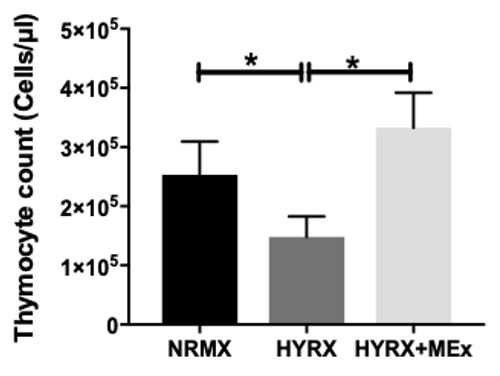
Extensive research on mice models proved the effectiveness of these exosomes on the development of thymic tissue, through preventing thymic degeneration, as shown in the following graph, where there is a significant increase in the number of thymocytes following the administration of this therapy (Mex), even with the presence of hyperoxic stressor (HYRX)
 :
:
Benefits
- Treatment of the root cause of immunologic diseases, reducing the need for further supportive therapies, like antibiotics and immunoglobulins.
- Minimal adverse effects since this therapy is based on naturally occurring exosomes that can be individually generated for each individual, preventing the risks of further immune reactions.
- High cost-effectiveness on the individual level, as well as on the health system level, because this therapy would increase the life quality by reducing mortality from infections and morbidity of autoimmune disorders like type 1 diabetes and rheumatoid arthritis.
- Further clinical investigations can prove the effectiveness of this mode of therapy for treating other, poorly recognized, neonatal conditions that are responsible for lifetime diseases.
Applications
- Prevention of thymic degeneration for premature infants undergoing early resuscitation and oxygen therapy, preventing their higher tendency for acquiring infections.
- Early administration after birth for infants with genetic or other congenital disorders that lead to thymic degeneration or dysfunction.
- Prenatal administration for embryos at increased risk for thymic degeneration due to genetic disorders or prenatal congenital causes such as maternal infection.
- Administration during severe systemic infections to enhance the immune response against bacterial infections.
- With further research, the possibility to administer this therapy in individuals of families that were found to have polygenic causes of autoimmune disorders, such as type 1 diabetes, to prevent the development of such life-long severe disorders.
Publications
- Taglauer ES, Fernandez-Gonzalez A, Willis GR, Reis M, Yeung V, Liu X, Mitsialis SA, Kourembanas S. Mesenchymal stromal cell-derived extracellular vesicle therapy prevents preeclamptic physiology through intrauterine immunomodulation†. Biol Reprod. 2021 Feb 11;104(2):457-467. doi: 10.1093/biolre/ioaa198. PMID: 33112369; PMCID: PMC7876668.
- Fernandez-Gonzalez A, Willis GR, Yeung V, Reis M, Liu X, Mitsialis SA, Kourembanas S. Therapeutic Effects of Mesenchymal Stromal Cell-Derived Small Extracellular Vesicles in Oxygen-Induced Multi-Organ Disease: A Developmental Perspective. Front Cell Dev Biol. 2021 Mar 16;9:647025. doi: 10.3389/fcell.2021.647025. PMID: 33796534; PMCID: PMC8007882.